


Buying Guide
How to Buy an Electric Kitchen Composter
This quick guide explains what to look for when buying an electric kitchen composter, compares the main types, highlights must-have features, explains where to buy, and gives practical tips so you can choose the right unit for your home faster.
Key factors to consider
Capacity and household size: choose a capacity that matches how much food waste you produce. Options range from about 3 L for small households to 19 L for larger families.
Processing speed and throughput: models process waste in 4 to 8 hours or run continuously; check the daily processing limit (some units handle up to about 11 lb per day).
Compost quality: some machines use microbial degradation to produce true compost while others dehydrate or grind into pre-compost. Decide if you need ready-to-use nutrient material or a pre-compost that needs curing.
Odour control and filters: look for proven deodorization systems and know whether filters are permanent or replaceable. Replaceable carbon filters add ongoing cost.
Noise and placement: quieter units operate around 40 dB and are better for apartment or countertop use.
Maintenance and cleaning: check for self-cleaning cycles, removable non-stick buckets, and how often filters or parts must be replaced.
Power use and smart features: consider energy draw, app or WiFi features for tracking, and whether remote controls matter to you.
Price and warranty: expect a wide price range; compare included warranties and spare part availability.
Processing speed and throughput: models process waste in 4 to 8 hours or run continuously; check the daily processing limit (some units handle up to about 11 lb per day).
Compost quality: some machines use microbial degradation to produce true compost while others dehydrate or grind into pre-compost. Decide if you need ready-to-use nutrient material or a pre-compost that needs curing.
Odour control and filters: look for proven deodorization systems and know whether filters are permanent or replaceable. Replaceable carbon filters add ongoing cost.
Noise and placement: quieter units operate around 40 dB and are better for apartment or countertop use.
Maintenance and cleaning: check for self-cleaning cycles, removable non-stick buckets, and how often filters or parts must be replaced.
Power use and smart features: consider energy draw, app or WiFi features for tracking, and whether remote controls matter to you.
Price and warranty: expect a wide price range; compare included warranties and spare part availability.

Types and how they work
Microbial degradation units - use microbes to break down food into richer, plant-ready compost in hours; often promoted as producing "true" compost.
Thermal grind and dehydrate units - use heat and grinding to reduce volume and sanitize; output may need extra curing before gardening use.
Continuous add versus batch units - continuous units let you drop scraps in anytime; batch units require filling and running a cycle.
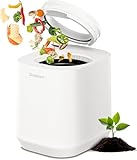
Countertop versus larger capacity units - countertop models (3 L to 5 L) suit couples or small families; larger cabinets or 10+ L units suit busy households or light commercial use.
Self-cleaning and smart models - some offer auto-clean cycles and app connectivity to monitor cycles and track carbon footprint.
Thermal grind and dehydrate units - use heat and grinding to reduce volume and sanitize; output may need extra curing before gardening use.
Continuous add versus batch units - continuous units let you drop scraps in anytime; batch units require filling and running a cycle.
Countertop versus larger capacity units - countertop models (3 L to 5 L) suit couples or small families; larger cabinets or 10+ L units suit busy households or light commercial use.
Self-cleaning and smart models - some offer auto-clean cycles and app connectivity to monitor cycles and track carbon footprint.
Where to buy and common mistakes to avoid
Online retail - best for selection, price comparisons, customer reviews, and delivery options. Confirm shipping times, return policy, and warranty support before buying.
Brick and mortar - good if you want to check footprint and noise in person before committing.
Common mistakes to avoid:
Brick and mortar - good if you want to check footprint and noise in person before committing.
Common mistakes to avoid:
- Buying a unit that is too small for your household waste volume.
- Ignoring ongoing filter or supply costs when the model uses replaceable filters.
- Assuming every machine makes ready-to-use compost; some outputs need further curing.
- Overlooking noise level if the unit will sit in the kitchen.
- Failing to check warranty and spare part availability.

Expert tips and quick checklist
Match capacity to your weekly waste - 3 L is fine for 1 to 2 people, 4 to 5 L for small families, 10+ L or continuous units for larger households.
Prioritize odour control and a low-maintenance filter system - permanent filters save money over time.
If you want minimal babysitting, pick a self-cleaning continuous-add model.
Check processing time and daily throughput if you cook a lot; faster cycles and higher reduction rates reduce trips to the trash.
Buy from a seller with clear returns and a warranty; look for at least a year of coverage.
Quick checklist:
Prioritize odour control and a low-maintenance filter system - permanent filters save money over time.
If you want minimal babysitting, pick a self-cleaning continuous-add model.
Check processing time and daily throughput if you cook a lot; faster cycles and higher reduction rates reduce trips to the trash.
Buy from a seller with clear returns and a warranty; look for at least a year of coverage.
Quick checklist:
- Capacity and daily throughput
- Processing method and compost readiness
- Noise level and footprint
- Filter type and replacement cost
- Self-clean and maintenance needs
- Warranty and return policy
Final Thoughts
Choose a unit by balancing capacity, maintenance and compost quality. For busy households prioritise larger capacity and continuous-add or fast-cycle microbial units with strong odour control and permanent filters. For small households prioritise quiet countertop models with easy cleaning. Always check warranty, filter costs, and return policy before you buy.