



Buying Guide
How to Buy an Electric Spin Scrubber
This short guide helps you pick the right cordless spin scrubber for bathrooms, kitchens and other home surfaces. It covers the key factors to check, the main types you will find, the most important specs to compare, where to shop and quick expert tips so you buy once and buy smart.
What to check before you buy
Battery and runtime:
Look for Type-C charging and at least 2,500 mAh if you want 60+ minutes of runtime. Smaller batteries may only run 30 to 40 minutes and are fine for quick jobs.
Water resistance and safety:
Choose an IPX7 rating or better but follow the manual. Many units are splash and wash friendly, but manufacturers often advise against running the motor fully submerged.
Brush heads and materials:
Motor speed and power:
Look for dual speed settings roughly between 320 and 480 RPM for daily cleaning and a deeper clean setting. Around 20 to 25 W is common for reliable performance.
Handle, reach and ergonomics:
Check extension range and whether the handle detaches. Telescopic handles that reach about 40 to 120 cm (16 to 47 in) make overhead and floor cleaning easier and reduce bending.
Look for Type-C charging and at least 2,500 mAh if you want 60+ minutes of runtime. Smaller batteries may only run 30 to 40 minutes and are fine for quick jobs.
Water resistance and safety:
Choose an IPX7 rating or better but follow the manual. Many units are splash and wash friendly, but manufacturers often advise against running the motor fully submerged.
Brush heads and materials:
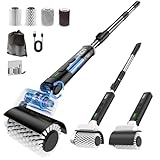
- At least 5 different heads gives versatility for grout, tubs, flat floors, corners and delicate surfaces.
- PP or nylon bristles clean well and are less likely to scratch; sponges and cloth pads are useful for windows and furniture.
Motor speed and power:
Look for dual speed settings roughly between 320 and 480 RPM for daily cleaning and a deeper clean setting. Around 20 to 25 W is common for reliable performance.
Handle, reach and ergonomics:
Check extension range and whether the handle detaches. Telescopic handles that reach about 40 to 120 cm (16 to 47 in) make overhead and floor cleaning easier and reduce bending.


Types and how to choose
Handheld compact units:
Best for sinks, tight spaces and spot cleaning. Choose these if you need a light, storable tool.
Spin scrubbers with extension handles:
Ideal for tubs, tiles and floors when you want to avoid kneeling. Pick a telescopic handle with a secure lock and comfortable grip.
Multi-angle or remote-controlled scrubbers:
If you want extra reach and flexible head angles for awkward corners, choose a model with adjustable head angles or remote control. These are helpful for larger bathrooms and for users with limited mobility.
Best for sinks, tight spaces and spot cleaning. Choose these if you need a light, storable tool.
Spin scrubbers with extension handles:
Ideal for tubs, tiles and floors when you want to avoid kneeling. Pick a telescopic handle with a secure lock and comfortable grip.
Multi-angle or remote-controlled scrubbers:
If you want extra reach and flexible head angles for awkward corners, choose a model with adjustable head angles or remote control. These are helpful for larger bathrooms and for users with limited mobility.
Where to buy and quick buying tips
Online shopping:
Pros: better selection, frequent deals and full spec lists. Check product images for included heads, read verified reviews, and confirm warranty and return policy before purchase.
Cons: you cannot try weight or handle feel before buying.
In-store shopping:
Pros: try the handle length, weight and balance in person. Ask staff about replacement brush availability.
Cons: selection may be limited and prices may be higher than online promotions.
Price and warranty:
Expect entry to mid range models around forty to fifty dollars. Prefer products with at least a one year warranty and clear after-sales support. Look for free shipping or promotion periods but prioritise warranty and returns over a small discount.
Pros: better selection, frequent deals and full spec lists. Check product images for included heads, read verified reviews, and confirm warranty and return policy before purchase.
Cons: you cannot try weight or handle feel before buying.
In-store shopping:
Pros: try the handle length, weight and balance in person. Ask staff about replacement brush availability.
Cons: selection may be limited and prices may be higher than online promotions.
Price and warranty:
Expect entry to mid range models around forty to fifty dollars. Prefer products with at least a one year warranty and clear after-sales support. Look for free shipping or promotion periods but prioritise warranty and returns over a small discount.

Common mistakes to avoid and expert recommendations
Common mistakes to avoid:
Expert recommendations:
- Buying on price alone without checking runtime and included brush heads.
- Using the wrong charger. Use the specified 5V USB charger when indicated.
- Assuming every brush head is scratch safe. Test on an inconspicuous area first.
- Running the motor fully submerged if the manual warns against it.
Expert recommendations:
- Choose a dual speed machine with at least 2,500 mAh battery and Type-C charging for best balance of power and convenience.
- Get a model that includes 7 to 9 brush heads if you plan to clean multiple surface types.
- Keep a spare set of heads on hand and clean them after use. Warm water can help reshape bent bristles.
- For large jobs choose a longer extension handle and a motor 20 W or higher.
- Buy from a seller with clear warranty terms and easy returns so you can test performance risk free.
Final Thoughts
Pick a scrubber that balances runtime, brush variety and an adjustable handle for your home tasks. Aim for Type-C charging, IPX7 splash protection, dual speeds and at least 5 brush heads. Buy where you can confirm warranty and returns, and avoid cheap units that skimp on battery or replacement parts.


